
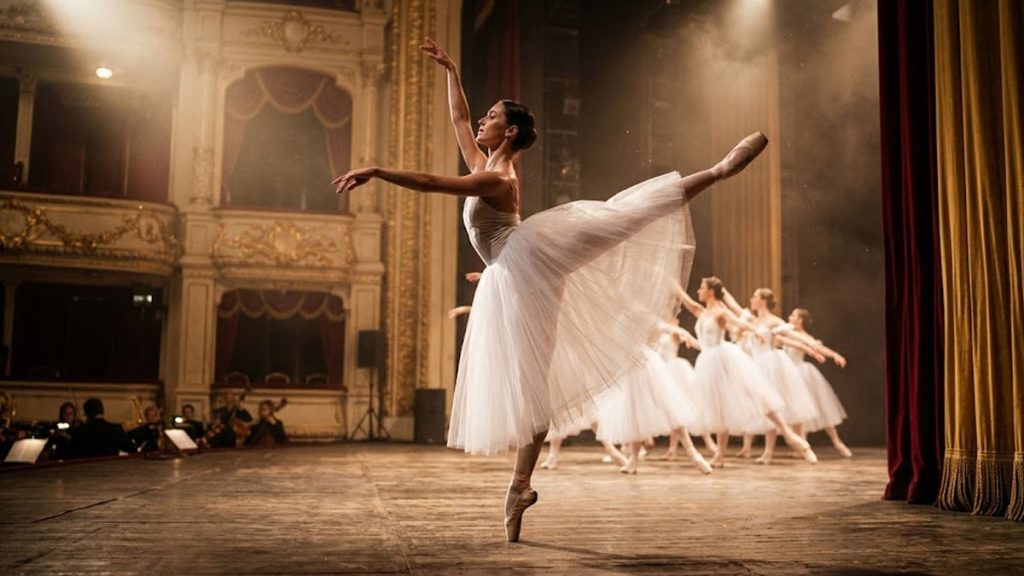
Behind the effortless jumps, soft landings, and ethereal smiles of a classical ballet performance lies one of the most physically and mentally exhausting disciplines in the world. Audience members sit back to enjoy a seamless story told through fluid motion, often forgetting that the dancers on stage possess the cardiovascular endurance of elite marathon runners and the raw strength of Olympic gymnasts.
Unlike sports where visible effort is celebrated, ballet requires athletes to make the impossible look completely weightless. This unique combination of rigorous physical output, mental fortitude, and strict technical precision keeps ballet firmly at the top as one of the most demanding art forms ever created.
The Illusion of Weightlessness
The defining characteristic of classical ballet is its intentional denial of gravity. When a male dancer lifts his partner high overhead or a ballerina executes a series of rapid turns across the stage, every muscle in their body works at maximum capacity. Yet, their expressions must remain entirely serene.
This requirement to hide physical exertion creates an incredible tax on the body. Professional dancers must develop deep core stability, extraordinary balance, and fine motor control just to maintain alignment. They push their heart rates into extreme training zones during long variations while maintaining a relaxed face and steady breath. The physical toll of sustaining high-intensity movement without displaying fatigue is a feat unique to performance arts like ballet.
Anatomy Turned Up side Down
The human body is naturally built for forward movement and parallel alignment. Ballet, however, asks the body to operate outside its anatomical comfort zone through turnout—the outward rotation of the legs from the hip sockets.
Achieving correct turnout without putting dangerous pressure on the knees or ankles takes years of targeted conditioning. Dancers spend thousands of hours strengthening tiny stabilizer muscles along the hips, glutes, and feet. On top of rotation, female dancers perform en pointe, supporting their entire body weight on the tips of their toes inside hardened satin shoes. The feet endure immense pressure, friction, and impact, making foot care, ankle strength, and structural resilience an absolute necessity for survival in the field.
The Pursuit of Flawless Precision
In many dance styles, individual flair and personal interpretation can disguise minor technical slip-ups. Ballet leaves no room for such concealment. The technique is codified down to the millimeter, meaning every finger placement, head angle, and foot position has a specific rule.
Because audiences and directors expect perfection, a dancer’s focus must never wave for a fraction of a second. Executing complex turns like fouetté turns requires flawless timing, precise spotting to prevent dizziness, and immaculate core engagement. A millimeter off-center can result in a fallen turn or, worse, a severe injury. This constant demand for spatial awareness and technical consistency subjects dancers to continuous mental focus during daily training and live shows.
Mental Fortitude and the Mastery of Rejection
The physical grind is only half the battle. The mental resilience required to endure a ballet career is equally intense. Training begins at an early age, involving hours in front of mirrors under constant scrutiny from teachers, choreographers, and the dancers themselves.
Dancers must learn to accept constructive criticism daily and process rejection during auditions without losing their motivation. Managing performance anxiety while stepping onto a bright stage in front of thousands demands psychological toughness. Dancers must quickly shake off minor errors mid-routine and keep performing with absolute confidence, proving that mental grit is just as essential as physical flexibility.
A Lifetime Commitment to an Unforgiving Craft
Unlike skills that can be picked up quickly, ballet demands a lifelong commitment. Professional dancers train for 6 to 8 hours a day, six days a week, balancing technique classes, rehearsals, cross-training, and physical therapy.
Despite modern advancements in sports science and conditioning, the core foundation of ballet remains rooted in centuries of uncompromising tradition. It asks everything of a person’s body, mind, and spirit. Yet, for those who step onto the stage, the ability to transform extreme discipline into pure art makes every grueling hour completely worth it.